

(Part 2)
Will HPCL and BPCL Be Forced to Respond?
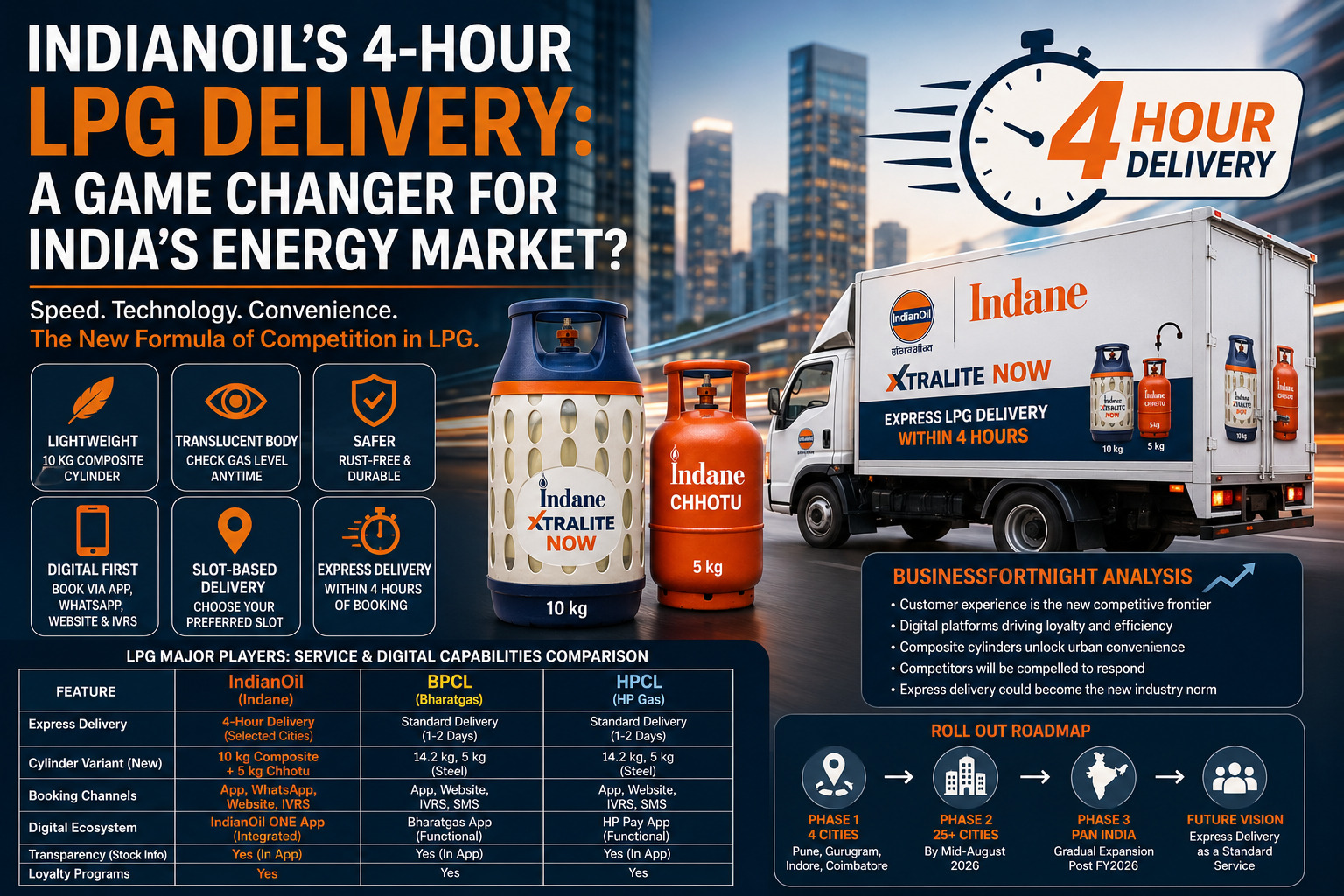
IndianOil’s initiative is likely to be watched closely by its two principal competitors—Bharat Petroleum Corporation Ltd. (BPCL) and Hindustan Petroleum Corporation Ltd. (HPCL).
The three public sector oil marketing companies have traditionally competed on network expansion, customer reach and digital services. However, customer experience has rarely been a major point of differentiation because domestic LPG has largely been viewed as a standardized product.
If IndianOil succeeds in creating a perception that speed is a competitive advantage, BPCL and HPCL may eventually have to introduce similar services in key urban markets.
The competitive response may not necessarily be identical. One company could focus on guaranteed delivery windows, another on subscription-based refills, while a third could bundle premium customer support with digital services. Whatever the approach, IndianOil has shifted the conversation from “Who supplies LPG?” to “Who delivers the best LPG experience?”
That is a significant strategic change.
Can the Four-Hour Promise Be Sustained?
Launching an express service is one challenge. Maintaining it at scale is another.
Unlike e-commerce products, LPG cylinders require physical inventory, safety compliance, trained delivery personnel and specialized vehicles. Traffic congestion, weather conditions and fluctuating demand can all affect delivery timelines.
During festivals or periods of exceptionally high consumption, distributors may find it difficult to consistently honour a four-hour commitment.
IndianOil’s long-term success will therefore depend on three critical capabilities:
- Accurate demand forecasting.
- Technology-driven route optimization.
- Distributor readiness and operational discipline.
If these systems function effectively, the service could become a benchmark. If not, customer expectations may outpace operational reality.
Why the 10 kg Composite Cylinder Matters
While much of the attention has focused on express delivery, the 10 kg composite cylinder deserves equal attention.
Composite cylinders represent a gradual modernization of LPG infrastructure.
Compared with conventional steel cylinders, they offer several practical advantages:
| Feature | 14.2 kg Steel Cylinder | 10 kg Composite Cylinder |
|---|---|---|
| Weight | Heavy | Significantly lighter |
| Corrosion | Can rust over time | Rust-free |
| LPG Level | Cannot be viewed externally | Transparent body shows LPG level |
| Portability | Moderate | High |
| Target Customer | General households | Urban consumers, senior citizens, professionals, small families |
For elderly consumers, apartment residents and households where cylinders must be carried over longer distances, reduced weight alone can significantly improve usability.
The transparent body is another notable innovation. One of the most common consumer complaints has been the inability to determine how much LPG remains. By allowing customers to visually estimate the remaining fuel, the composite cylinder addresses a long-standing inconvenience.
The Economics Behind Express Delivery
Introducing a premium service inevitably raises questions about cost.
Even if IndianOil does not levy an additional delivery fee during the rollout phase, express fulfilment is unlikely to be cost-neutral.
Faster delivery generally requires:
- Higher vehicle utilization.
- Better inventory positioning.
- More flexible staffing.
- Stronger digital infrastructure.
- Continuous monitoring of delivery performance.
However, these costs may be offset by long-term gains:
- Improved customer retention.
- Higher adoption of premium cylinder variants.
- Increased digital engagement through the IndianOil ONE ecosystem.
- Greater operational efficiency through technology.
Rather than viewing express delivery solely as an expense, IndianOil may be treating it as a strategic investment in customer loyalty.
A New Role for Digital Platforms
The launch also reinforces the growing importance of digital ecosystems in India’s energy sector.
The IndianOil ONE App is no longer simply a booking platform. It is gradually evolving into a customer relationship platform where booking, payment, service requests and delivery management converge.
If the company continues this trajectory, future services could include:
- Predictive refill reminders based on usage patterns.
- AI-assisted customer support.
- Real-time delivery tracking.
- Subscription-based refill plans.
- Smart-home integration for automatic booking alerts.
These possibilities are no longer speculative. Similar service models already exist in industries such as food delivery, mobility and e-commerce.
The energy sector may be the next frontier.
The Global Perspective
Composite LPG cylinders are already used in several international markets, particularly where portability, corrosion resistance and safety are valued.
What distinguishes IndianOil’s initiative is not merely the product, but the combination of:
- Lightweight composite technology.
- Digital booking.
- Express fulfilment.
- Preferred delivery slots.
- Nationwide distribution capability.
Taken together, these elements represent a service innovation rather than just a hardware upgrade.
Challenges That Cannot Be Ignored
Despite its promise, the initiative faces several challenges.
Scalability: A successful pilot in a handful of cities does not automatically guarantee nationwide operational success.
Distributor economics: Smaller distributors may require additional investments in manpower, technology and fleet management.
Consumer awareness: Many households are still unfamiliar with composite cylinders and may require education regarding their benefits.
Infrastructure differences: Delivery expectations in metropolitan areas differ significantly from those in Tier-2 and Tier-3 cities.
Addressing these issues will determine whether the initiative remains a premium urban service or evolves into a nationwide standard.
BusinessFortnight Analysis
Viewed strategically, Indane XTRALITE NOW is less about launching a new cylinder and more about redefining what consumers expect from a utility provider.
Historically, oil marketing companies have competed on scale, supply security and pricing. IndianOil is now testing whether service quality can become an equally powerful differentiator.
The timing is noteworthy. Urban India has embraced app-based services that prioritize convenience, transparency and speed. Consumers increasingly judge brands not only by the quality of their products but also by the quality of their experience.
IndianOil appears to be responding to this shift.
If the four-hour delivery model proves commercially sustainable, competitors are likely to introduce comparable offerings, potentially triggering a broader transformation in India’s LPG distribution landscape.
The initiative also hints at a larger trend: the convergence of traditional energy businesses with digital service platforms. As customer expectations continue to evolve, operational excellence may become just as important as production and distribution capacity.
Whether express LPG delivery eventually becomes the industry norm remains uncertain.
What is already clear, however, is that IndianOil has taken the first decisive step in redefining the future of domestic LPG service in India.
In business, products build markets. Service builds leadership. IndianOil is betting that the next phase of competition will be won through the latter.

