

By BusinessFortnight Editorial Desk
For decades, booking an LPG cylinder in India has followed a familiar routine. A consumer places an order, waits for a confirmation, and expects delivery within a day or two—sometimes longer depending on local demand, distributor workload and logistics. The system has largely worked because LPG is a planned purchase rather than an emergency requirement.
IndianOil is now attempting to change that consumer mindset.
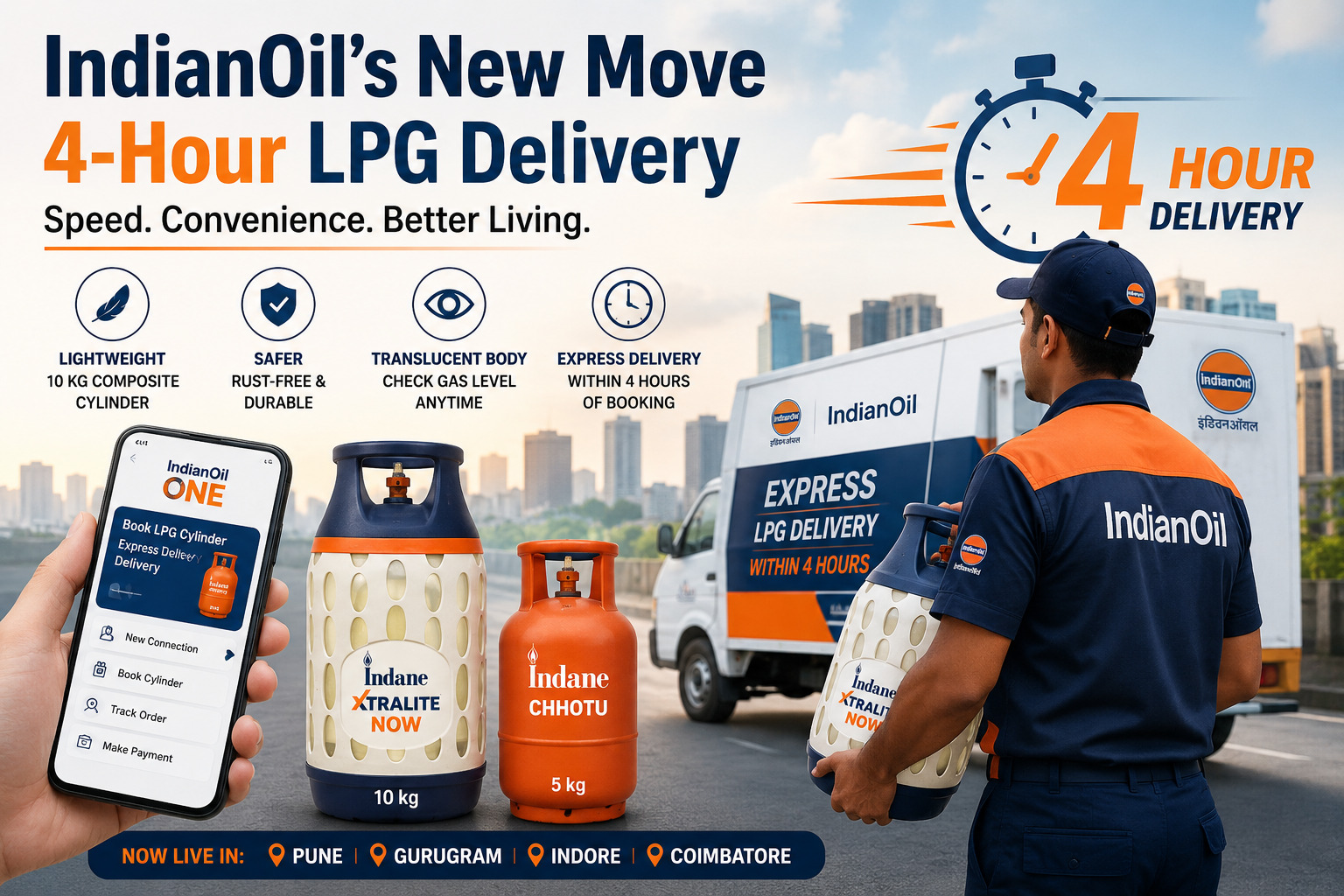
With the launch of Indane XTRALITE NOW, a lightweight 10 kg composite LPG cylinder backed by an express delivery promise, the country’s largest oil marketing company is no longer merely selling cooking fuel. It is attempting to sell speed, convenience and a premium customer experience.
The decision may appear incremental at first glance. After all, it currently covers only a 10 kg composite cylinder and the 5 kg Chhotu cylinder in selected cities. However, from a business strategy perspective, the initiative has the potential to become one of the most significant transformations in India’s domestic LPG ecosystem in recent years.
The larger question is not whether consumers will appreciate four-hour delivery. They almost certainly will.
The real question is whether this marks the beginning of a new competitive era where customer experience becomes as important as the product itself.
A Market That Has Reached Maturity
India’s domestic LPG market is among the largest in the world. Over the past decade, government initiatives promoting clean cooking fuel have dramatically expanded LPG penetration across urban and rural households.
Today, the competitive landscape is dominated by three public sector oil marketing companies:
- IndianOil (Indane)
- Bharat Petroleum (Bharatgas)
- Hindustan Petroleum (HP Gas)
Traditionally, competition among these companies has revolved around distribution reach, dealer network expansion, refill availability and pricing policies governed under the public distribution framework.
Customer service innovations have generally been limited to:
- Mobile booking
- SMS booking
- Online payment
- Mobile applications
- IVRS systems
- Digital subsidy tracking
IndianOil’s latest initiative suggests the next phase of competition may no longer revolve around booking convenience alone—but around delivery speed.
That represents an important strategic shift.
Why the Timing Matters
Several structural changes are influencing consumer behaviour in urban India.
The rise of quick-commerce platforms has fundamentally altered customer expectations. Consumers have become accustomed to receiving groceries, medicines, electronics and daily essentials within minutes or hours.
Whether ordering food, booking a cab or buying household supplies, urban consumers increasingly associate convenience with immediate fulfilment.
Cooking gas remained one of the few essential household services still operating on a traditional delivery cycle.
IndianOil appears to have recognised that changing expectation.
Instead of asking customers to continue accepting conventional delivery timelines, the company is experimenting with a service model that mirrors modern urban consumption patterns.
This is not merely an operational improvement.
It is a repositioning exercise.
Rather than being viewed only as a fuel supplier, IndianOil wants to be perceived as a technology-enabled consumer services company.
Why Begin With a 10 kg Composite Cylinder?
Many observers have questioned why IndianOil chose a relatively niche 10 kg composite cylinder instead of immediately offering express delivery for the standard 14.2 kg domestic cylinder.
The answer is likely rooted in logistics.
Composite cylinders are significantly lighter than conventional steel cylinders, making transportation easier and reducing handling effort for delivery personnel.
Their compact size also enables more efficient loading and unloading in congested urban environments where delivery productivity matters.
From a pilot programme perspective, launching express delivery with a lighter cylinder reduces operational complexity while allowing IndianOil to test customer response before expanding the concept.
The strategy resembles product testing frequently seen in consumer technology sectors.
Launch in selected markets.
Gather operational data.
Refine logistics.
Scale nationally.
That approach reduces execution risk.
The Premium Convenience Economy
Consumers today are increasingly willing to pay for convenience.
Subscription-based deliveries.
Same-day shipping.
Express courier services.
Priority airport check-ins.
Premium banking.
Fast-track healthcare.
These services demonstrate that convenience itself has become a monetisable product.
IndianOil’s express LPG delivery aligns closely with this broader economic trend.
Although the company has not positioned the service as a premium paid offering, it is creating additional value around the customer experience rather than the physical product.
That distinction is strategically important.
The LPG inside the cylinder remains identical.
The customer experience changes dramatically.
In today’s service economy, experience often creates stronger brand loyalty than price differences.
Digital Transformation Beyond Booking
IndianOil has invested substantially in digital infrastructure over the past several years through its mobile application, customer portal and digital payment ecosystem.
The launch of Indane XTRALITE NOW demonstrates how digital investments are beginning to influence physical service delivery.
Instead of digitalisation ending at online booking, it now extends into fulfilment.
Customers can:
- Register digitally
- Book digitally
- Track deliveries
- Choose preferred delivery slots
- Receive faster fulfilment
This represents an integrated digital customer journey.
Such integration is increasingly becoming the benchmark across multiple industries.
Energy companies can no longer rely solely on infrastructure strength.
Digital customer engagement is becoming equally important.
Urban India Is the Primary Target
The initial rollout cities—Pune, Gurugram, Indore and Coimbatore—offer an important clue regarding IndianOil’s market strategy.
These cities share several characteristics.
They have rapidly growing middle-class populations.
Large apartment communities.
High smartphone penetration.
Strong digital payment adoption.
Growing numbers of working professionals.
Increasing demand for convenience-led services.
These are precisely the demographics most likely to value faster LPG delivery.
Interestingly, IndianOil has not begun with metro cities alone.
Instead, it has chosen a combination of metropolitan and emerging urban centres.
This suggests the company sees India’s next wave of premium consumer demand extending beyond Delhi, Mumbai and Bengaluru.
The Distributor Challenge
While consumers are likely to welcome four-hour delivery, the initiative creates significant operational expectations for Indane distributors.
Express delivery requires more than additional delivery personnel.
It demands:
- Better inventory planning.
- Accurate demand forecasting.
- Faster order processing.
- Improved route optimisation.
- Real-time communication.
- Higher delivery reliability.
For distributors accustomed to conventional delivery schedules, this could require meaningful investments in technology, workforce management and fleet operations.
The challenge becomes even greater during seasonal demand spikes, festivals and adverse weather conditions.
Maintaining a four-hour commitment consistently across different geographies will test the resilience of IndianOil’s distribution network.
More Than Just a Product Launch
Viewed in isolation, Indane XTRALITE NOW appears to be the launch of another LPG cylinder variant.
Viewed strategically, it represents something much larger.
It reflects IndianOil’s recognition that future competition in the energy sector will increasingly be driven by customer experience rather than product differentiation alone.
In many mature industries, companies eventually discover that improving service creates greater competitive advantage than introducing entirely new products.
The domestic LPG market may now be entering that phase.
(Part 2 will examine whether HPCL and BPCL are likely to respond, the economics of express LPG delivery, the challenges of scaling the model nationwide, and whether this initiative could permanently reshape India’s domestic LPG industry.)

