

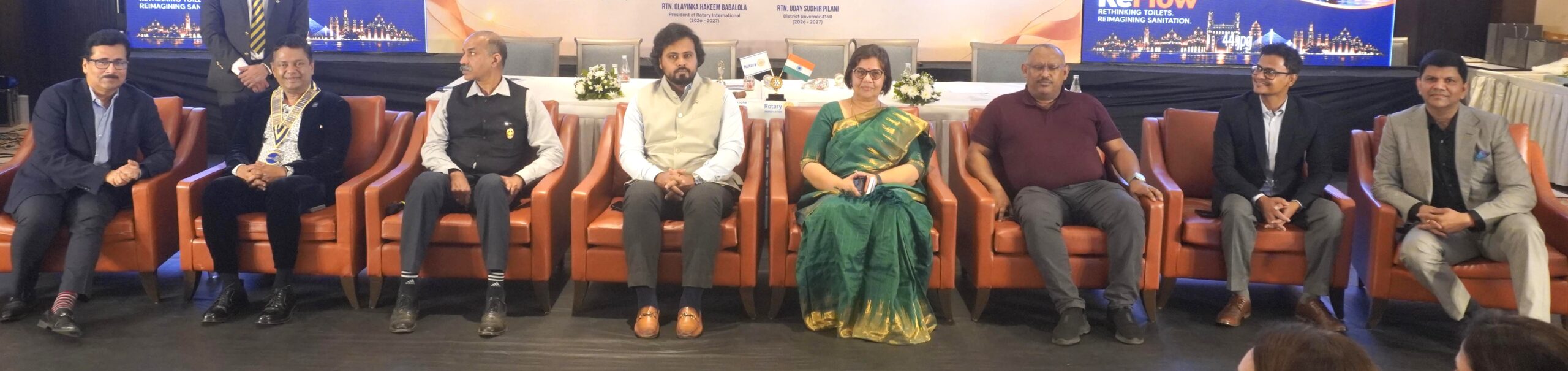
Hyderabad, October 17, 2026: The Rotary Club of One Hyderabad convened a panel discussion titled “Sanitation: A Super Vaccine” on the eve of its Charter Presentation Ceremony, with experts calling for increased investment, technological innovation, and behavioural change to make sanitation a public health priority.
The event, held at The Leela in Banjara Hills, Hyderabad, brought together senior government officials, development-sector representatives and industry leaders to discuss how improved sanitation systems and collective responsibility can transform health outcomes in rapidly urbanising communities.
Panel highlights need for systemic change
The discussion was moderated by Prof. V. Srinivas Chary, former Director of the Administrative Staff College of India and Advisor to T-Works, Dasra and the Gates Foundation, along with Abhishek Nath, Founder of LooCafe and ReFlow. Prof. Chary noted that in countries such as Japan, sanitation is prioritised even before major infrastructure projects, and called for India to revisit its development priorities to treat sanitation as foundational to a healthy society.
Dr. T. K. Sridevi, IAS, Secretary, Municipal Administration Department and Commissioner and Director of Municipal Administration (CDMA), Government of Telangana, highlighted the ambiguity around responsibility for cleanliness, which often relegates sanitation to the background. She recalled Mahatma Gandhi’s focus on sanitation during the freedom struggle and called for a shift away from the “flush and forget” approach, urging greater investment and sustained behavioural change.
Sanitation as a ‘super vaccine’
Dr. Zelalem Birhanu Tafesse, Chief of Field Office, UNICEF India, described sanitation as a “super vaccine,” stating that effective sanitation and handwashing can prevent illness and protect communities. He cited Rotary’s collaboration with UNICEF in the fight against polio, noting that in Uttar Pradesh and Bihar, Rotary facilitated over 7,000 volunteers, demonstrating the impact of community mobilisation on public health.
Vivek Pandey, WASH Professional and Consultant to the Gates Foundation, underscored the need for innovation in sanitation technology, pointing out that many cities still rely on systems unchanged for over 160 years. He advocated for decentralised wastewater treatment and reuse, highlighting the ReFlow Model toilet at Lumbini Park, Hyderabad, where wastewater is treated on-site and recovered water is reused, reducing dependence on conventional sewage systems.
Residential communities and sustainable practices
Girish Mallpani, Chairman and Managing Director of MPM Group, stressed the importance of effective Effluent Treatment Plants and wastewater management in residential communities. He urged Resident Welfare Associations to ensure treatment systems are adequate and maintained, and encouraged homebuyers to inquire about wastewater treatment plans when purchasing luxury homes.
Col. M. Chandan Kumar, Head of Engineering at T-Works, discussed the need for affordable and scalable sanitation technologies, emphasising the importance of bridging the gap between innovation and widespread adoption.
Sanitation’s broad impact on development goals
Rohit Chandragiri of the British Deputy High Commission (FCDO) highlighted that sanitation directly or indirectly impacts 130 of the 169 United Nations Sustainable Development Goal targets, underlining its strategic importance for public health, gender equality, education, and environmental protection.
District Governor Uday Pilani, Rotary District 3150, reiterated Rotary’s commitment to community service and its ability to mobilise collective action for sanitation, calling for collaboration among government, industry, civil society and communities.
The panel concluded that achieving lasting change in sanitation requires a comprehensive approach combining infrastructure, technology, wastewater recycling, behavioural change and institutional collaboration, with coordinated action from all stakeholders.
Disclaimer: This article is based on a press release provided by the concerned organisation and has been edited for style and clarity with the assistance of AI tools. BusinessFortnight does not verify, endorse, or take responsibility for the claims, figures, or statements made in the original release.

