

Mumbai, October 26, 2026: India’s green hydrogen sector could attract investments of US$180–200 billion through 2030, but faces persistent challenges in production costs, infrastructure and certification, according to a new report by CARE ESG Ratings Limited.
The report, titled “Why Green Hydrogen Is Becoming an Industrial Strategy Question,” highlights that green hydrogen is increasingly central to India’s industrial competitiveness and decarbonisation, with significant implications for steel, fertilisers, refining and chemicals. The sector’s development is now tied not only to climate goals but also to export competitiveness and energy security, as India aims to position itself as a major producer of low-carbon industrial materials.
Impact of carbon border taxes
The urgency for green hydrogen adoption is heightened by the European Union’s Carbon Border Adjustment Mechanism (CBAM), which imposes carbon-linked costs on imports of carbon-intensive goods. The report estimates that Indian steel exporters could face costs of $70–190 per metric tonne on shipments to the EU, potentially rising above $270 per metric tonne if default emissions values are applied.
According to Nikunj Dube, Chief Ratings Officer at CareEdge-ESG, India’s green hydrogen ambitions must be realised through commercially viable projects, supported by reliable offtake agreements, competitive production costs and robust infrastructure. Dube noted that effective execution will determine adoption pace, with opportunities spanning the value chain from electrolyser manufacturing and renewable energy to storage, transportation and end-use applications.
Cost and adoption hurdles
Green hydrogen currently costs approximately ₹350–450 per kg, compared to ₹160–200 per kg for conventional grey hydrogen. The report projects that costs could fall to around US$2.4 per kg by 2030, driven by cheaper renewable electricity, lower electrolyser costs and project scaling. Until then, policy support, carbon pricing and assured industrial demand will be crucial for adoption.
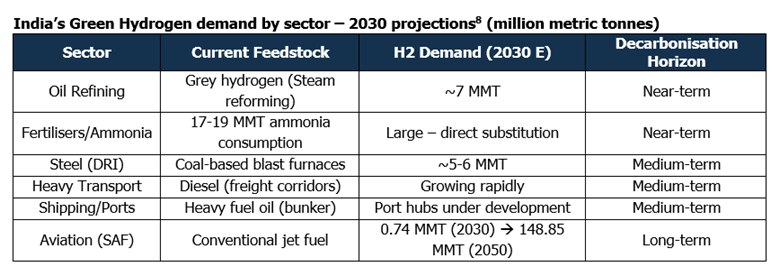
Fertilisers and steel are identified as key demand drivers. India consumes about 17–19 million metric tonnes of ammonia annually, mostly produced from natural gas. Green ammonia could help reduce fossil-fuel imports and emissions. An August 2025 Solar Energy Corporation of India auction set a benchmark bid price of ₹49.75 per kg, but the withdrawal of two out of 13 offtakers highlighted execution challenges.
India produced approximately 164.9 million metric tonnes of steel in 2025, making it the world’s second-largest steel producer. The report notes that reducing emissions intensity will become increasingly important as carbon-related trade requirements evolve.
Slow deployment despite targets
The National Green Hydrogen Mission, launched in January 2023 with an outlay of ₹19,744 crore, targets at least 5 million metric tonnes of annual green hydrogen production by 2030. However, as of February 2026, only about 8,000 tonnes per year of production capacity had been commissioned in India.
Globally, announced low-emissions hydrogen projects could deliver 27 million tonnes per annum by 2030, but only slightly more than 6 million tonnes per annum are at the operational, construction or final investment decision stage. The report emphasises the need for financing, infrastructure and long-term offtake agreements to close this gap.
Corporate commitments and certification
Major Indian corporates have announced significant investments: Reliance Industries plans to invest ₹75,000 crore in a vertically integrated green energy ecosystem, Adani Enterprises has committed over US$50 billion for green hydrogen over the next decade, and NTPC has proposed a green hydrogen hub in Andhra Pradesh. The report cautions that actual deployment will depend on financial closure, assured demand and viable operating models.
Scaling the sector will require investment in storage, pipelines, port infrastructure and reliable offtake. India’s Green Hydrogen Certification Scheme, introduced in 2025, provides a framework for traceability and aims to align with international standards on renewable electricity sourcing and emissions verification to support export access. The report also notes India’s dependence on imported electrolyser components, highlighting the need for domestic manufacturing and policy continuity.
CARE ESG Ratings concludes that green hydrogen can help decarbonise sectors where direct electrification is difficult, but bridging the gap between investment commitments and operational capacity, while improving costs and infrastructure, will be critical for India’s industrial competitiveness.
Disclaimer: This article is based on a press release provided by the concerned organisation and has been edited for style and clarity with the assistance of AI tools. BusinessFortnight does not verify, endorse, or take responsibility for the claims, figures, or statements made in the original release.

