

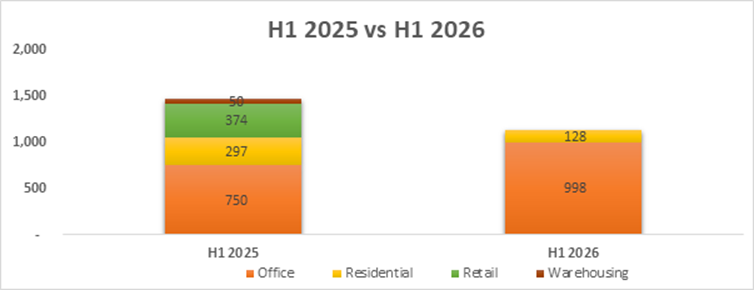
Knight Frank India, the leading international property consultancy, in its latest report Trends in Private Equity Investment in India: H1 2026, records that private equity (PE) investments in Indian real estate totaled USD 1.13 bn during H1 2026, marking a 23% year-on-year (YoY) decline from USD 1.47 bn recorded in the same period last year. Office continued to remain the preferred asset class for investment with 89% of PE investment in H1 2026, while the residential sector received the remaining. National Capital Region (NCR) recorded maximum investment amongst the top eight cities of India.
The moderation in investment activity reflects more selective capital deployment amid elevated global interest rates, tighter financial conditions, and heightened geopolitical uncertainty. Importantly, the report underscores that this decline does not signal any weakening of India’s real estate fundamentals. Rather, it points to an evolving global investment landscape, where institutional investors are increasingly prioritizing risk-adjusted returns, liquidity, and execution certainty over growth potential alone.
NCR emerged as the leading destination for private equity investments in H1 2026, recording a remarkable 522% YoY increase in inflows to USD 411.1 mn, compared with USD 66 mn in H1 2025. Accounting for over one-third of total PE investments during the period, the region’s performance was driven by a balanced mix of office and residential transactions, ongoing infrastructure expansion, and a growing corporate occupier ecosystem. Pune followed with USD 355.9 mn of investments, supported by selective residential transactions and its position as an office and manufacturing hub. Chennai attracted USD 154.7 mn, benefiting from strong industrial, logistics, and commercial real estate fundamentals.
The office sector was the strongest-performing asset class during H1 2026, accounting for nearly 89% of all PE investments in Indian real estate. Investments in the segment rose by 33% to USD 998 mn, compared with USD 579 mn during H1 2025. Investor preference was overwhelmingly skewed towards ready office assets during H1 2026, with completed properties accounting for approximately 75% of total office investments, up from 53% in H1 2025.
Private equity investments in the residential sector declined from USD 297 mn in H1 2025 to USD 128 mn in H1 2026, as investors adopted a more cautious and selective approach towards development-led opportunities. However, despite the moderation, the residential real estate continues to benefit from increasing formalisation and sustained end-user demand across key markets.
Knight Frank India notes that the absence of major transactions in warehousing and retail sectors does not indicate a decline in the attractiveness of these asset classes. India’s long-term real estate fundamentals remain firmly intact, supported by rapid urbanisation, economic expansion, and a steady stock of investment-grade assets. While global capital flows are expected to remain selective in the near term, sectors backed by strong occupier demand and stable income profiles are likely to attract investor interest. The next phase of capital inflows into Indian real estate will be driven by the capacity to deliver predictable post-tax, risk-adjusted returns.

