Sign in Join
  • Automobile
    • Two Wheelers
    • Four Wheelers
    • Commercial-Vehicles
  • Aviation
  • Corporate
  • Healthcare
    • Health-Technologies
    • Hospitals
    • Lifestyle
    • Pharma
  • Hospitality
    • Travels
  • Real Estate
Sign in
Welcome!Log into your account
Forgot your password?
Create an account
Privacy Policy
Sign up
Welcome!Register for an account
A password will be e-mailed to you.
Privacy Policy
Password recovery
Recover your password
Search
Logo
Sign in
Welcome! Log into your account
Forgot your password? Get help
Create an account
Privacy Policy
Create an account
Welcome! Register for an account
A password will be e-mailed to you.
Privacy Policy
Password recovery
Recover your password
A password will be e-mailed to you.
Wednesday, October 14, 2026
Sign in / Join
  • Automobile
    • Two Wheelers
    • Four Wheelers
    • Commercial-Vehicles
  • Aviation
  • Corporate
  • Healthcare
  • Hospitality
  • Real Estate
Facebook
Instagram
Twitter
Vimeo
Youtube
Logo
  • Automobile
    • Two Wheelers
    • Four Wheelers
    • Commercial-Vehicles
  • Aviation
  • Corporate
  • Healthcare
    • AllHealth-TechnologiesHospitalsLifestylePharma
      Healthcare

      Two Brothers Recover from Severe Injuries After Accident, Treated at Manipal Hospitals Momstory

      October 14, 2026
      Healthcare

      Sparsh Hospice marks 15 years, becomes India’s first NABH-accredited hospice

      October 14, 2026
      Healthcare

      Ova Ferticon 2026 draws over 200 reproductive medicine experts to Thane

      October 14, 2026
      Lifestyle

      Crossword Book Awards 2026 announces jury shortlist across five categories

      October 14, 2026
  • Hospitality
    • AllTravels
      Hospitality

      India’s hotel investment surges 197% in H1 2026, JLL projects USD 1.1 bn for year

      October 14, 2026
      Hospitality

      Taj Lakefront Bhopal concludes seven-day Satpura cuisine festival

      October 11, 2026
      Hospitality

      TAWI LUSH joins Skål International to expand global hospitality network

      October 9, 2026
      Hospitality

      Wet’nJoy Lonavala launches Maharashtra’s first Glow Garden experience

      October 7, 2026
  • Real Estate
HomeAutomobileReserve ensures survival of rare monkeys
Automobile

Reserve ensures survival of rare monkeys

Ravindra Soni
By Ravindra Soni
August 4, 2023
0
413
Share
Facebook
Twitter
Pinterest
WhatsApp
    Reserve ensures survival of rare monkeys

    [ad_1]


    China Daily: Reserve ensures survival of rare monkeys


    KUNMING, China, Aug. 3, 2023 /PRNewswire/ — A news report from China Daily:

    Dedicated rangers are helping to ensure that one of China’s most endangered species is flourishing. Zhang Wenfang and Li Yingqing report from Kunming.
    Yu Jianhua (left), a forest ranger at the Baima Snow Mountain National Nature Reserve in Yunnan province, is joined by Lai Jiandong (middle), head of the wildlife protection station at the reserve, and French travel writer Yannick Benichou as they check the feces of Yunnan snub-nosed monkeys to monitor the animals' health in March. [Photo / China Daily]
    Yu Jianhua (left), a forest ranger at the Baima Snow Mountain National Nature Reserve in Yunnan province, is joined by Lai Jiandong (middle), head of the wildlife protection station at the reserve, and French travel writer Yannick Benichou as they check the feces of Yunnan snub-nosed monkeys to monitor the animals’ health in March. [Photo / China Daily]
    Long Yongcheng (left), a primatologist, discusses the monkeys with Benichou in Xiangguqing village, Yunnan, in March. [Photo / China Daily]
    Long Yongcheng (left), a primatologist, discusses the monkeys with Benichou in Xiangguqing village, Yunnan, in March. [Photo / China Daily]
    Long and Yu teach Benichou about the monkeys in Xiangguqing. [Photo / China Daily]
    Long and Yu teach Benichou about the monkeys in Xiangguqing. [Photo / China Daily]
    Yu and his companions patrol the Baima reserve as they look for traces of Yunnan snub-nosed monkeys in March. [Photo / China Daily]
    Yu and his companions patrol the Baima reserve as they look for traces of Yunnan snub-nosed monkeys in March. [Photo / China Daily]
    Two monkeys sit high in a tree at the reserve. [Photo / China Daily]
    Two monkeys sit high in a tree at the reserve. [Photo / China Daily]
    Parents nurse their infant at the reserve. [Photo / China Daily]
    Parents nurse their infant at the reserve. [Photo / China Daily]

    The number of endangered Yunnan snub-nosed monkeys is rising, thanks to growing public awareness and concrete action, according to experts at a nature reserve.

    “On Jan 29, Xiangguqing village welcomed its first Yunnan snub-nosed monkey baby born in the Year of the Rabbit,” announced Lai Jiandong, head of the wildlife protection station at the Baima Snow Mountain National Nature Reserve in northwestern Yunnan province, in a WeChat post earlier this year.

    The post was accompanied by a video clip showing the mother in the woods, holding her newborn with one hand as she picked up peanuts with the other.

    “This marks an auspicious start (to the breeding season),” Lai wrote.

    When the Yunnan snub-nosed monkey breeding season ended in late May, Lai was pleased to see that the monkeys in the village had given birth to 12 infants, bringing their total population to about 80.

    “It is also a good sign for the reproductive activities of many other monkey troops who live deeper in the mountain’s forests,” Lai said.

    Yunnan snub-nosed monkeys inhabit the mountainous forests of the southwestern province and the neighboring Tibet autonomous region, with most of them being found in the Baima reserve. Xiangguqing, in Yunnan’s Dechen Tibetan autonomous prefecture, is the only place where people can observe the monkeys in close proximity.

    Over the decades, the Yunnan snub-nosed monkey, one of world’s most endangered primates, has been saved from extinction. According to a survey conducted in 2017-18, the population had risen to more than 3,800, while in the 1980s the monkey was rarely seen.

    A decadelong journey

    In the 1980s, when the Baima reserve was established to protect the precious species, no one knew exactly how many of the monkeys remained or where they were, because they had disappeared from human sight for about 100 years.

    The mystery surrounding the primate intrigued Long Yongcheng, then a researcher at the Kunming Institute of Zoology. He first visited the reserve in 1985 on a trip that led to a lifelong bond with the animals.

    “Even the reserve’s staff members didn’t know what the monkeys looked like. They didn’t have a single clear photo of the primate. They once even mistook some macaque monkeys for the Yunnan monkey,” he recalled.

    Yunnan snub-nosed monkeys have a distinctive appearance: black-and-white fur, pink pouting lips, a punky “mohawk” hairstyle and a tail that’s roughly as long as the body.

    “How can we protect a species without even knowing any basic information about it?” said Long, who was determined to find the monkeys.

    From 1985 to 1994, Long and two assistants, who were the first members of staff at the reserve, left their footprints all over the narrow mountain ranges between the Jinsha and Lancang rivers as they searched for the elusive primates.

    “Every search was an adventurous journey. We had to venture deep into the primary forests at altitudes of 3,000 to 5,000 meters. Supplies were carried by horses to sustain our weekslong trips to the mountains. Sometimes, fickle weather and rugged terrain put our lives at risk,” Long recalled.

    They caught fleeting glimpses of the primate in the trees or observed large groups from a distance, but it wasn’t until June 1992 that Long managed to take the first clear photo of the monkeys in the wild as they sat on high cliffs about 100 meters away. Later, his team found 20 groups of the monkeys — 1,000 to 1,500 in total — living in the primary forests, often known as “old growth forests”, in the border area between Yunnan and Tibet.

    Growing awareness

    Long’s expeditions were also often joined by special guides — hunters from local villages.

    “Wherever I went, the first thing I did was find the best local hunters. They were excellent climbers and had detailed knowledge of the area’s geography and fauna,” Long said.

    The local residents used to live off the mountains. They chopped down trees for firewood and building materials, and hunted wild animals, including the snub-nosed monkeys, for their meat and fur.

    Large-scale commercial logging led to the shrinking and fragmentation of the monkeys’ habitat, while hunting added to the challenges they faced.

    “The hunters were not absolute villains. A lack of environmental and wildlife protection awareness meant that most of them were unaware that their way of life was destructive to nature,” Long said.

    “Once, I told a hunter that Yunnan snub-nosed monkeys only lived in his home area, and he was super surprised.”

    Over the years, Long made the acquaintance of 30 to 40 hunters, and they are all now employed as forest protectors.

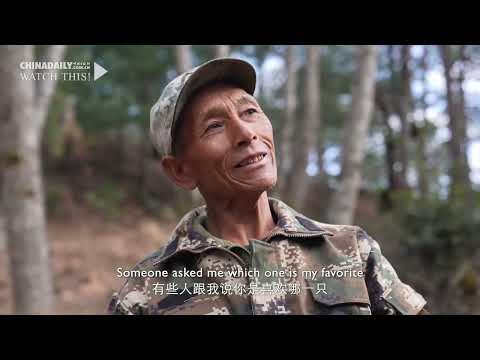
    Yu Jianhua, a 70-year-old former hunter in Xiangguqing, has worked at the reserve for 26 years. His hunting career, which began in his teens, ended in 1997 after the local government persuaded him to use his skills and knowledge to protect the endangered monkeys.

    “Although I was a hunter, I actually quite like animals and nature. When I learned that the monkeys were an endangered species, I became their protector,” he said.

    “The deteriorating natural environment had already affected my hunting business. I was worried that one day all the trees would be gone and the monkeys and other animals would no longer exist in the village.”

    After he turned in his shotgun, Yu started tracking and protecting the monkeys. “At first, they ran away at the sight of me and kept a watchful eye on me from very far away,” he said, adding that as time passed, the animals came to recognize his voice and appearance so they stayed where they were when he approached, eating and resting as usual.

    Many other hunters followed Yu’s example, so the village’s guardian team has grown to 25 people.

    They hand out food, monitor the monkeys’ health and daily activities and offer assistance when needed. Other tasks include preventing poaching and illegal logging, and clearing hidden dangers such as traps.

    In 2008, to raise public awareness of the Yunnan snub-nosed monkey, a national park was built around Xiangguqing, which lies within the Baima reserve, and opened to visitors, thus allowing people to observe the monkeys at elevations of 2,400 to 3,100 meters.

    The monkeys usually live at the highest altitudes, but some have been guided by Yu and other rangers to settle in areas more accessible to people. However, it would not be possible for the monkeys to move to lower ground without the trust and bonds forged between them and their protectors.

    “I see them as my own kids. I miss them when I leave the village, even if it’s only for a few days. I’ll continue my ranger work until the day I can no longer walk,” Yu said.

    Since the park opened, he has had an extra duty: managing the tourists and introducing them to the monkeys’ world. By the end of last year, the facility had received about 250,000 visits, becoming a significant window to popularizing the treasured species.

    Deeper understanding

    “I like the shutter sounds made by visitors’ cameras and phones because that means their images and videos will be spread online and all over the world, making more people fans of this unique species,” said Long, now a 68-year-old retiree and honorary chairman of the Chinese Primatological Society.

    “More attention brings better protection. Keeping the monkeys alive is still a matter of urgency. Only while they are a living species can we maintain the opportunity to deepen our understanding of them.”

    The monkeys, dubbed “elves of the snow mountain” by the locals, live at the highest altitudes at which all primates (with the exception of humans) can survive, according to Long.

    “High altitude often means extreme conditions and low temperatures. The monkeys don’t have much fat, so how they survive is a good question to explore. It also sheds light on how nature’s recycling system works,” he said.

    “The monkeys mainly eat usnea, a type of lichen that contains a substance called chitin, which is also found in the shells of crabs and shrimps. We humans and many other animals can’t digest it, but the monkeys can. Usnea (aka “old man’s beard”) often grows in the woods, so it’s eaten and digested by the monkeys, whose feces is broken down by natural processes. The ecosystem doesn’t produce waste. Everything is recyclable. Maybe we can learn from it to improve human society.”

    Comparing the maps of habitats of humans and other primates in China, Long noticed an overlap between many of the regions favored by primates and by humans.

    “The monkeys share many similarities with us humans. To protect them is to protect ourselves. A lot of questions remain about them and their interaction with nature. We should make more efforts to save biodiversity before it’s too late,” Long said.

    According to Lai Jiandong, from the wildlife protection station at the Baima reserve, five nature reserves, including Baima, have been set up over recent decades, providing more effective protection of the Yunnan snub-nosed monkey.

    In 2019, a protection network consisting of the local government and NGOs was established, and the number of member organizations has risen from 13 to 28. Over the past three years, ecological corridors totaling more than 400 hectares have been built or restored, with 630,000 trees planted, which has facilitated gene exchanges among different groups of monkeys.

    “The conservation of the Yunnan snub-nosed monkey is on the right track and my dream of saving the species has been realized. Now, as a retiree, I just hope that one day this black-and-white monkey will be as popular as the black-and-white giant panda,” Long said.

    Click on the link to watch the video on the rebirth of the elves of the snow mountain: https://youtu.be/m4tBlyQGFOY

    SOURCE chinadaily.com.cn


    Reform brings rural community new life

    More news releases in similar topics



    PRN Top Stories Newsletters

    Sign up to get PRN’s top stories and curated news delivered to your inbox weekly!

    Thank you for subscribing!

    By signing up you agree to receive content from us.
    Our newsletters contain tracking pixels to help us deliver unique content based on each subscriber’s engagement and interests. For more information on how we will use your data to ensure we send you relevant content please visit our PRN Consumer Newsletter Privacy Notice. You can withdraw your consent at any time in the footer of every email you’ll receive.

    Mit Ihrer Anmeldung erklären Sie sich damit einverstanden, Inhalte von uns zu erhalten.
    Unsere Newsletter enthalten Zählpixel, die die Lieferung einzigartiger Inhalte in Bezug auf das Abonnement und die Interessen der einzelnen Abonnenten ermöglichen. Weitere Informationen über die Verwendung Ihrer Daten im Hinblick auf die Zusendung von relevanten Inhalten, finden Sie in unserer PRN Consumer Newsletter Privacy Notice. Ihre Zustimmung können Sie jederzeit in der Fußzeile jeder erhaltenen E-Mail widerrufen.

    En vous inscrivant à la newsletter, vous consentez à la réception de contenus de notre part.
    Notre newsletter contient des pixels espions nous permettant la fourniture à chaque abonné, d’un contenu unique en lien avec ses souscriptions et intérêts. Pour de plus amples informations sur l’utilisation faite de vos données en vue de l’envoi des contenus concernés, nous vous invitons à consulter la politique de confidentialité disponible à partir du lien suivant PRN Consumer Newsletter Privacy Notice. Vous pouvez à tout moment revenir sur votre consentement par le biais des informations situées au bas de chaque e-mail reçu.

    Регистрирайки се, Вие се съгласявате да получавате информационно съдържание от нас. Нашите бюлетини съдържат проследяващи пиксели, които ни помагат да предоставяме уникално съдържание въз основа на ангажираността и интересите на всеки абонат. За повече информация относно начина, по който ще използваме Вашите данни, за да гарантираме, че Ви изпращаме подходящо съдържание, моля, направете справка с нашето Уведомление за поверителност на потребителския бюлетин на PRN. Можете да оттеглите съгласието си по всяко време в долния колонтитул на всеки от имейлите, които ще получите.


    [ad_2]

    Source by [author_name]

    Share this:

    • Share on Facebook (Opens in new window) Facebook
    • Share on X (Opens in new window) X

    Like this:

    Like Loading…

    Related

    • Tags
    • chinadaily.com.cn
    • Ensures
    • monkeys
    • Rare
    • reserve
    • survival
    Share
    Facebook
    Twitter
    Pinterest
    WhatsApp
      Previous article
      Dog DNA Test Market 2023 | Competitive Insights and Outlook 2030
      Next article
      AGCO Agriculture Foundation to Donate BRL 240000 to Amigos do Bem institution
      Ravindra Soni
      Ravindra Sonihttps://businessfortnight.com
      Senior journalist with 38 years of experience in print and digital media. Former Executive Editor. Founder and Editor of BusinessFortnight, covering business, economy, and policy news from Madhya Pradesh and across India.
      RELATED ARTICLES
      Automobile

      Cars24 delivers 750 cars on first day of Navratri, 58% rise year-on-year

      October 12, 2026
      Automobile

      Cars24 delivers 750 cars on first day of Navratri, 58% rise year-on-year

      October 12, 2026
      Automobile

      Škoda Auto India launches new Slavia sedan, prices start at ₹9.99 lakh

      October 7, 2026

      LEAVE A REPLY

      Please enter your comment!
      Please enter your name here
      You have entered an incorrect email address!
      Please enter your email address here

      Most Popular

      Marsh and Bloomberg New Economy launch Competitive Resilience Coalition at New Delhi forum

      October 14, 2026

      Haier Appliances India launches new premium home appliances portfolio

      October 14, 2026

      Federal Bank launches ‘Festive Dreams’ campaign with special loan rates and discounts

      October 14, 2026

      Sophos launches AI Defense to detect shadow AI and secure enterprise AI use

      October 14, 2026
      Load more

      Recent Comments

      EDITOR PICKS

      Marsh and Bloomberg New Economy launch Competitive Resilience Coalition at New Delhi forum

      October 14, 2026

      Haier Appliances India launches new premium home appliances portfolio

      October 14, 2026

      Federal Bank launches ‘Festive Dreams’ campaign with special loan rates and discounts

      October 14, 2026

      POPULAR POSTS

      Marsh and Bloomberg New Economy launch Competitive Resilience Coalition at New Delhi forum

      October 14, 2026

      Haier Appliances India launches new premium home appliances portfolio

      October 14, 2026

      Federal Bank launches ‘Festive Dreams’ campaign with special loan rates and discounts

      October 14, 2026

      POPULAR CATEGORY

      • Corporate7185
      • Automobile5073
      • Healthcare4574
      • Technology4314
      • Entertainment2768
      • Market1898
      • Aviation1838
      Logo

      ABOUT US

      BusinessFortnight (businessfortnight.com) is an Indian digital news and media platform that covers business, economy, banking, insurance, real estate, automobiles, aviation, and hospitality news

      Contact us: editorbusinessfortnight(@)gmail.com

      © BusinessFortnight.com. All Rights Reserved.

      • Automobile
      • Aviation
      • Corporate
      • Healthcare
      • Hospitality
      • Real Estate
      %d