

Mumbai, October 21, 2026: PL Asset Management, the asset management arm of PL Capital Group, has reported a significant correction in Indian equities for September 2026, with the Nifty 50 index falling 6.06%—its worst September since 2018—amid global economic headwinds and record foreign institutional selling.
The firm’s PMS Monthly Newsletter for September highlighted that Brent crude prices surpassed $100 per barrel due to Gulf supply disruptions, while the rupee weakened 0.68% to ₹95.83 per US dollar by month-end, after touching a record low of about ₹96.35. The US 10-year Treasury yield rose to 5.29% and the US Federal Reserve, along with the Bank of Japan, raised interest rates during the month, intensifying pressure on Indian markets.
Domestic investors offset foreign outflows
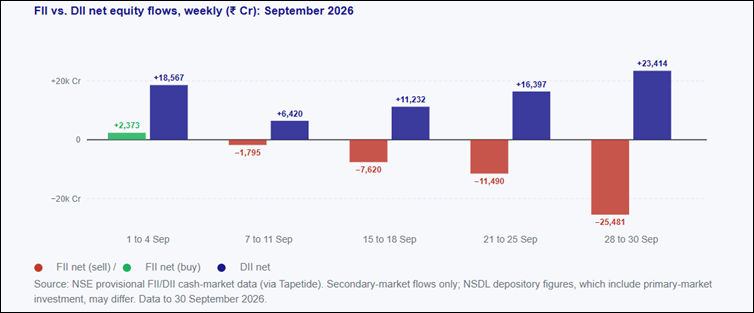
Foreign institutional investors (FIIs) recorded net equity selling of ₹44,013 crore in September, reversing the buying seen in July and August. Sectors such as IT, financials, and autos were among those most affected. In contrast, domestic institutional investors (DIIs) purchased ₹76,030 crore in equities, acting as net buyers in all 21 trading sessions and absorbing about 1.7 times the foreign selling. Systematic investment plan (SIP) flows also reached a record high during the month.
Despite the market correction, domestic economic indicators remained robust. Industrial output grew 8.0% in August, September’s flash purchasing managers’ indices (PMIs) indicated renewed momentum, and FY27 GDP growth forecasts were revised upwards by 50 to 100 basis points. Q1 FY27 earnings exceeded expectations, with Nifty profit after tax growth reaching a 10-quarter high.
Valuations reset across market segments
The correction led to a decline in equity valuations, particularly among large-cap stocks. The Nifty 50’s 12-month blended forward price-to-earnings (P/E) multiple dropped to 17.4x, below its long-term mean of 19.6x. The Nifty Midcap 150 traded at 25.4x against a long-term mean of 27.4x, while the Nifty Smallcap 250 remained above its historical average at 23.1x versus a mean of 20.9x. The Nifty 500 stood at 19.4x, compared to its long-term mean of 20.9x.
Large-cap multiples have now fallen below their long-term average, while small caps continue to trade above theirs. The outlook for market returns will depend on earnings delivery and the potential for a valuation re-rating, the firm said.
Strategy performance and outlook
PL Asset Management’s AQUA strategy returned −2.45% in September, outperforming its benchmark BSE 500 TRI, which declined 5.57%, resulting in an alpha of 3.12 percentage points. The strategy benefited from a 17% cash allocation and minimal exposure to the IT sector, which fell 11.2% during the month. LEAP, TRINITY, and ELEVATE strategies also outperformed their respective benchmarks, while ATOM and MADP underperformed due to sector-specific pressures and declines in both gold and equities.
Siddharth Vora, Head – Quant Investment Strategies & Fund Manager at PL Asset Management, said the firm’s defensive positioning helped mitigate losses during the volatile month. “Brent went back above $100, the rupee touched a record low, the Fed and Bank of Japan raised rates, and the situation in Hormuz worsened. The Nifty fell 6.06%, its worst September since 2018. This was not a domestic growth scare. Industrial output grew 8.0% in August, September’s flash PMIs pointed to renewed momentum, and FY27 GDP forecasts have been revised up by 50 to 100 bps. The foreign return we flagged last month did not last, with FIIs selling ₹44,013 crores, but DIIs bought ₹76,030 crores and were net buyers in every one of the month’s 21 sessions,” Vora said.
Focus on earnings and global factors
Looking ahead, PL Asset Management noted that the upcoming Q2 FY27 results in October will be crucial in assessing the impact of higher crude prices and input costs on corporate margins. The direction of monetary policy by the Reserve Bank of India, US Federal Reserve, and Bank of Japan, as well as movements in oil prices, the rupee, and global bond yields, will remain key external variables.
The firm’s assessment is that domestic growth and institutional flows will continue to support Indian equities, but with less margin for error than previously. The focus is expected to shift towards large caps and earnings quality, with future returns likely to be driven by a combination of earnings delivery and potential valuation re-rating.
Disclaimer: This article is based on a press release provided by the concerned organisation and has been edited for style and clarity with the assistance of AI tools. BusinessFortnight does not verify, endorse, or take responsibility for the claims, figures, or statements made in the original release.

