

By BusinessFortnight Bureau
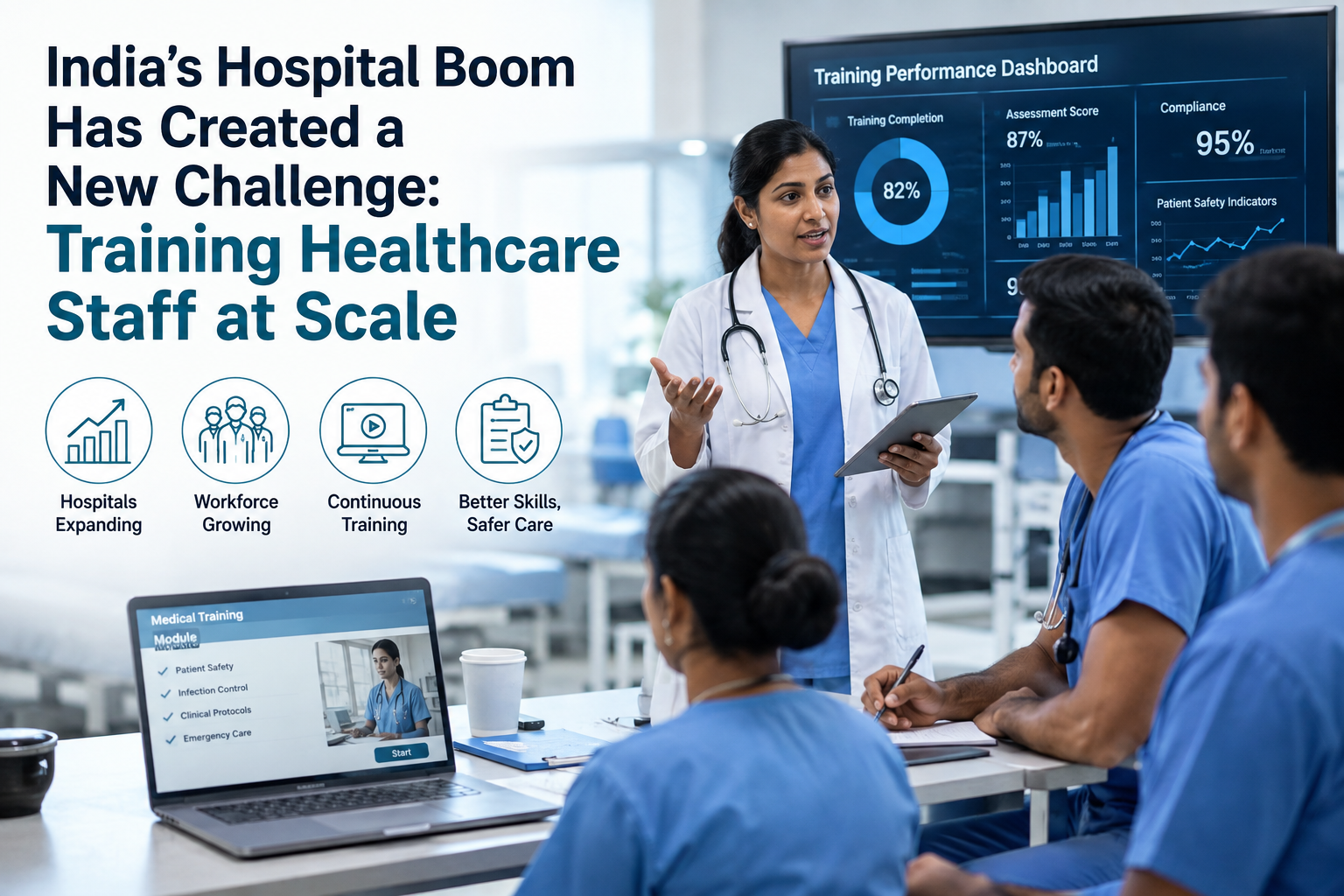
India’s healthcare industry is entering a period of rapid expansion, with investments in hospitals, medical infrastructure, technology and insurance coverage creating new opportunities for providers. But as hospitals add beds, departments and technologies, another challenge is becoming increasingly important: how quickly can they build and continuously upgrade the workforce needed to deliver consistent quality care?
The challenge is not simply about recruiting doctors, nurses and other healthcare professionals. Hospitals also need to ensure that their existing workforce can keep pace with changing clinical protocols, new technologies, digital systems, accreditation requirements and evolving expectations around patient experience.
For hospital operators, therefore, workforce training is increasingly becoming an operational issue rather than merely an HR function.
Scaling hospitals means scaling skills
As healthcare organisations expand, they bring more employees, processes and technologies into an increasingly complex operating environment. New staff have to be familiarised with institutional protocols, while existing employees need regular updates as procedures, technologies and standards change.
According to Deepak Sharma, Co-Founder & CEO, MedLern, continuous training needs to become part of the way hospitals operate rather than being treated as an occasional compliance exercise.
 “Continuous training is not only about meeting mandatory CME or CNE requirements. It is also about helping hospital teams respond when routines change, protocols are updated or new technology enters daily practice,” Sharma said.
The issue becomes particularly significant during periods of rapid expansion, when hospitals may have to onboard large numbers of employees while simultaneously maintaining their existing standards of patient care.
Training is moving beyond the classroom
Traditionally, hospital training has often been associated with classroom sessions, workshops and mandatory programmes. But the growing complexity of healthcare operations is pushing hospitals towards more continuous and accessible forms of learning.
Digital platforms can allow employees to access training material more regularly and provide hospital administrators with a clearer picture of participation and assessment.
This is particularly relevant for large hospital chains and institutions operating across multiple locations, where maintaining consistency in training can be difficult.
The objective is not simply to ensure that employees have completed a course. Hospitals increasingly need to understand whether training is translating into better compliance, improved processes and safer patient care.
The data behind training
This is where data is beginning to change the way hospitals look at workforce development.
Training records can be linked with assessments, audit findings, patient feedback and other operational indicators to help hospital managers understand where gaps exist and whether interventions are making a difference.
Sharma believes this shift is important because training should increasingly be assessed on outcomes rather than participation alone.
“Digital learning is not just about participation. It is about whether the hospital is running more safely, smoothly and with fewer gaps in daily care,” he said.
For hospital managements, such data can potentially provide insights into areas such as compliance, employee readiness, patient experience and accreditation preparedness.
NABH and the quality imperative
The growing emphasis on hospital accreditation is another factor increasing the importance of structured and continuous training.
Quality standards require hospitals to establish systems and processes that are followed consistently. That makes workforce awareness and competency an important part of maintaining institutional standards.
Training, therefore, increasingly sits at the intersection of quality management, patient safety, risk management and operational efficiency.
For hospitals, the challenge is to ensure that training does not become another box-ticking exercise. The real value lies in embedding learning into everyday operations.
The next competitive advantage may be workforce readiness
India’s hospital sector is likely to remain a major investment area as healthcare demand expands and more patients seek organised medical care.
But physical infrastructure alone cannot determine the quality of a hospital.
Two institutions may have similar facilities and medical equipment but deliver very different patient experiences depending on how well their teams understand processes, communicate with patients and respond to changing clinical and operational requirements.
That makes workforce readiness an increasingly important part of hospital competitiveness.
For hospital companies expanding rapidly, the ability to recruit, train, assess and continuously upgrade employees could ultimately become as important as adding beds and acquiring new technology.
The next phase of India’s hospital growth, therefore, may not be defined only by how many hospitals are built or how many beds are added, but also by how effectively healthcare organisations can ensure that their people are prepared to operate them.
And that could make continuous workforce learning one of the less visible — but increasingly important — infrastructure investments in India’s healthcare industry.

