

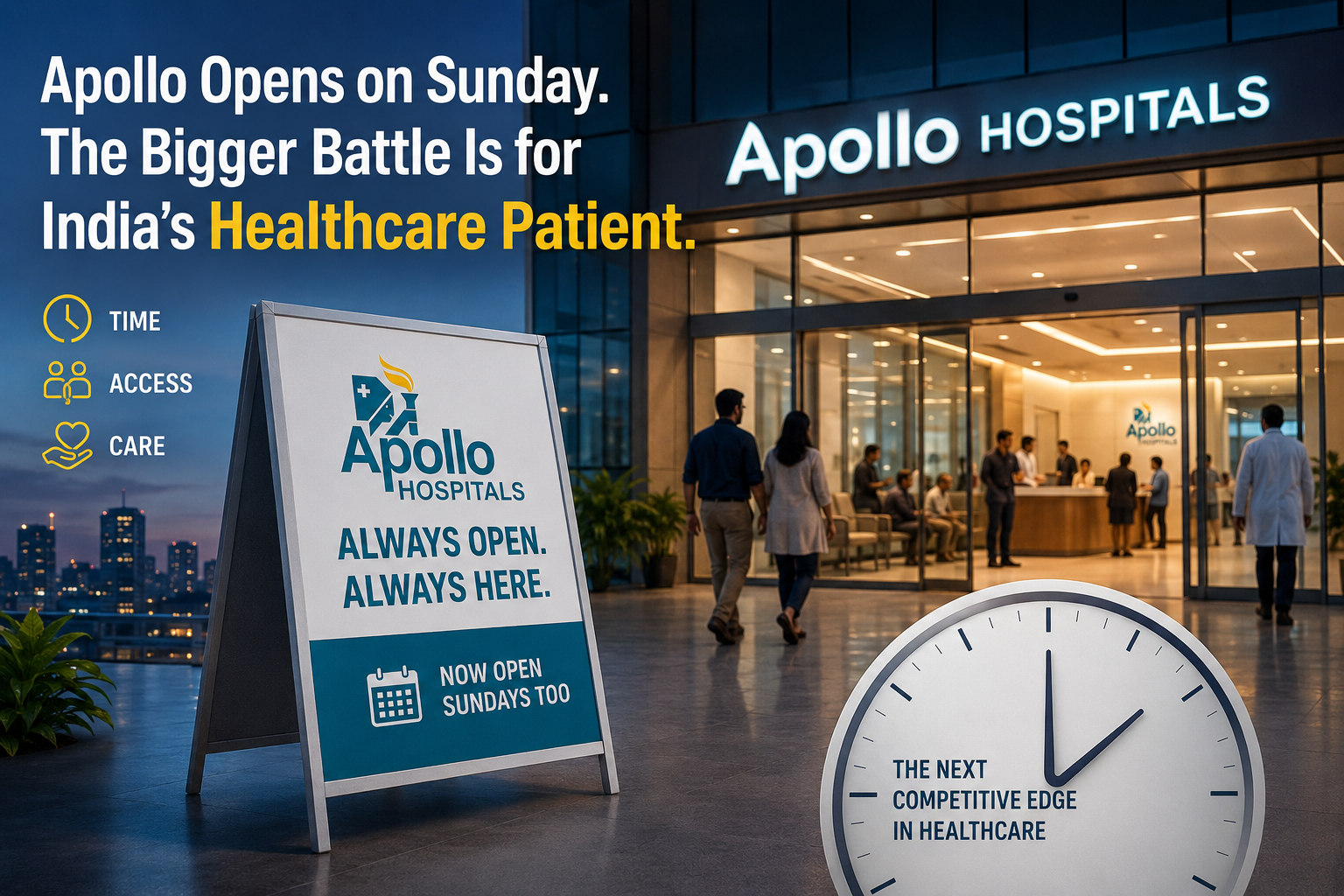
India’s private hospital giants are not fighting for survival. They are fighting for growth — and the next competitive advantage could be who captures more of the patient’s time, attention and healthcare journey.
New Delhi, August 20, 2026: What if the next time you choose a hospital, one of the questions is not which doctor? or how much will it cost? but simply: “Can I get an appointment on Sunday?”
Apollo Hospitals may be about to make that question more relevant.
Its new “Always Open. Always Here.” initiative extends routine consultations, diagnostics, preventive health checks, follow-ups and scheduled procedures to Sundays, subject to hospital-specific availability. Emergency, critical care and inpatient services were already available round the clock.
On the surface, it is a convenience initiative. Look deeper, however, and it arrives at an interesting moment for India’s private hospital industry.
The sector is not struggling for patients. It is growing rapidly. The bigger challenge is winning a larger share of the growth.
India’s private hospitals are thriving — so why the race?
CRISIL Ratings expects India’s private hospital sector to grow 14–15% in FY27, marking the fifth consecutive year of double-digit revenue growth. Healthy occupancy, rising revenue per occupied bed and the addition of new beds are expected to support the expansion.
The latest numbers from the major listed hospital chains tell a similar story.
Apollo reported ₹7,043 crore in consolidated Q1 FY27 revenue, up about 21% year-on-year, while profit attributable to owners rose to ₹581 crore. EBITDA increased 28% to ₹1,092 crore.
Max Healthcare reported Q1 revenue of ₹2,982 crore, up 16%, with network operating EBITDA rising 15% to ₹704 crore and PAT reaching ₹357 crore.
Fortis reported consolidated revenue of ₹2,545 crore, up 17.5%, while operating EBITDA rose 15.8% to ₹568 crore. Its hospital business revenue increased 19%.
Even Narayana Health reported a 78% increase in Q1 FY27 revenue to ₹2,684 crore and a 40% rise in EBITDA, although its EBITDA margin fell sharply from 23.9% to 18.8%.
So this isn’t a story about hospital giants fighting to survive.
It is a story about what happens when an attractive, profitable market gets crowded with ambitious players.
More beds. More hospitals. More competition.
The next clue is coming from the industry’s expansion plans.
Apollo plans to add more than 5,800 beds over the next five years.
Manipal Health, meanwhile, entered the public markets this year with an IPO that attracted strong institutional demand. The company has more than 13,000 beds across 49 hospitals and plans to add another 2,400 beds over the next three to four years.
Max is expanding through new hospitals and acquisitions, including a planned 450-bed facility in Pune and its entry into Bhubaneswar through the acquisition of a 250-bed hospital.
Fortis is also expanding its network, while its Q1 results show that occupied beds increased 16.7% year-on-year even as overall occupancy remained around 69%.
Put these moves together and a bigger question emerges:
If India’s leading hospital chains are all adding beds and facilities, where will the next wave of patients come from?
That is where the competition gets interesting.
The battle is no longer just about building hospitals
For years, the organised hospital story was relatively straightforward: build capacity, attract doctors, invest in technology and capture the growing demand for complex medical treatment.
That model is still working.
But as the major chains become larger, capacity alone becomes less of a differentiator.
A new hospital needs patients.
A new bed needs to be occupied.
A new diagnostic facility needs tests.
And a new specialist clinic needs appointments.
That shifts the competitive question from:
“How many hospitals do you have?”
to:
“How effectively can you attract and retain patients?”
Apollo’s Sunday move fits neatly into that equation.
Apollo may be competing for something more valuable than a bed
Consider a working professional who has been postponing a health check.
Monday to Saturday may be difficult. Sunday is free.
If Apollo is available on Sunday while another hospital isn’t, the decision suddenly becomes easier.
And the value of that Sunday appointment may not end with the consultation.
A preventive check can lead to diagnostics. Diagnostics can lead to a specialist consultation. A consultation can lead to treatment and follow-up.
For an integrated healthcare chain, the first patient interaction can become the beginning of a much longer relationship.
That makes access itself a competitive tool.
Apollo has not disclosed how much additional revenue it expects from Sunday operations, so it would be premature to describe the initiative as a proven revenue strategy.
But the strategic possibility is difficult to ignore:
more availability can create more opportunities to enter the patient’s healthcare journey.
And this is where the margins matter
The industry may be growing rapidly, but growth does not automatically translate into proportionately higher profits.
Fortis is a good example.
Its Q1 FY27 revenue grew 17.5% and operating EBITDA rose 15.8%, but PAT increased only 2.3% to ₹273 crore. Hospital EBITDA margin was 21.5%, compared with 22.1% a year earlier.
Narayana’s Q1 EBITDA rose 40%, but its EBITDA margin fell from 23.9% to 18.8%.
This doesn’t indicate a sector in distress. Rather, it shows the other side of rapid expansion: new facilities, acquisitions, staffing and ramp-up costs can affect margins even when demand is strong.
For hospital chains, therefore, the challenge is increasingly twofold:
grow — and grow efficiently.
The new hospital race may have four parts
The competitive game now appears to be moving towards a combination of:
Build — add new hospitals and beds.
Buy — acquire established hospitals and patient bases.
Optimise — improve occupancy and utilisation of existing infrastructure.
Differentiate — give patients another reason to choose one network over another.
Apollo’s Sunday initiative sits in the fourth and third categories.
It potentially differentiates the network while also creating another operating window for its existing infrastructure.
That may be why a seemingly simple scheduling decision deserves attention.
Could Sunday become a new competitive battleground?
Weekend healthcare itself is not new globally, and Sunday outpatient services already exist in different forms in various healthcare systems.
Apollo’s more significant move is to turn seven-day access to routine healthcare into a large, branded network-wide proposition.
If patients begin to value that convenience, competitors could face an uncomfortable question:
If Apollo is available on Sunday, can we afford not to be?
That could trigger a new form of competition.
Not necessarily a race to keep every department open every Sunday, but greater investment in:
- weekend specialist clinics
- diagnostics
- preventive health packages
- follow-up services
- digital appointment systems
- extended operating hours
And the consequences could extend beyond the large chains.
A large hospital network has more ability to spread the cost of weekend operations across a broad patient base. Smaller hospitals may find it harder to do so.
So greater competition on convenience could potentially become another advantage for scale.
The patient may ultimately be the winner
There is an important caveat.
Seven-day healthcare only works if patients actually use it.
Doctors, nurses, technicians and support teams have to be available. Hospitals have to generate enough demand to justify the additional operating cost.
Apollo’s own announcement says Sunday services will depend on hospital-specific schedules and readiness.
So the success of the strategy will not be determined by the announcement itself.
It will be determined by patient behaviour.
Will people who postponed healthcare because of time actually turn up on Sundays?
If they do, Apollo may have discovered a relatively simple way to make its healthcare network more accessible while deepening patient engagement.
If competitors follow, the impact could be much larger.
The bigger healthcare war
India’s private hospital industry is entering an unusual phase.
It is growing, profitable and attracting capital — but precisely because the opportunity is so large, the fight for the next share of the market is becoming more intense.
The battle is no longer simply about who can build the biggest hospital.
It is increasingly about who can offer the right doctor, at the right location, at the right price, at the right time — and then keep the patient within its healthcare ecosystem.
Apollo’s Sunday initiative may therefore prove to be more than a change in hospital timings.
It could be an early sign of where the next phase of India’s private healthcare competition is heading:
from competing for beds to competing for patients’ time.

