

[ad_1]
CGTN examines reasons behind the resilience and vitality of the Chinese economy. China is unswervingly deepening reform and opening up, advancing self-reliance in science and technology, ensuring the autonomy of industrial chains, and strengthening the internal drivers of economic growth — all key factors behind the remarkable performance of China‘s economy at the start of the 15th Five-Year Plan.
BEIJING, April 28, 2026 /PRNewswire/ — The Chinese economy has started strong in the 15th Five-Year Plan period (2026-2030) despite external pressure and trade tensions, according to the meeting the Political Bureau of the CPC Central Committee held on Tuesday. The economic growth remains steady, industrial capacity continues to improve, and policy support is helping stabilize expectations.
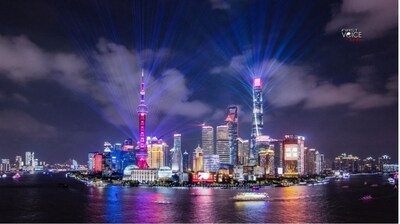
For an economy of China’s scale, maintaining this level of momentum not only proves its resilience but also its capacity to adapt and keep advancing under changing conditions.
The policy direction of the 15th Five-Year Plan, instead of relying primarily on land, property, and heavy investment, as the old growth playbook was wont to, is turning toward technology, innovation, and high-quality development.
By focusing on new quality productive forces – high-tech, high efficiency and high quality, in line with the new green development philosophy – China is aiming not just to grow faster but to grow smarter, with better productivity, stronger competitiveness, and more sustainable development.
During the January-March period, high-tech manufacturing saw strong growth, with profits rising 47.4%, adding 7.9 percentage points to overall industrial profit growth, according to the National Bureau of Statistics. Rapid advances in AI and semiconductor-related industries boosted profits in optical fiber manufacturing by a whopping 336.8%, optoelectronic device manufacturing (43%), and display device manufacturing (36.3%).
The 15th Five-Year Plan comes at a time when China is making steady progress in opening-up. China currently has 23 pilot free trade zones, which account for about 20% of the country’s foreign investment and trade. The negative list for foreign investment, which tabulates the sectors out of bounds for foreign investors, has been shortened to 29 items. Notably, all restrictions on foreign investment in manufacturing have been removed.
China’s opening-up is no longer only about trade volume or foreign investment. It is increasingly about institutional openness, market access, improved business environments, and stronger alignment with international standards.
At the same time, domestic demand is becoming an important engine of growth. At a press briefing on April 17, the National Development and Reform Commission said there would be a special action plan to expand domestic demand from 2026 to 2030.
As the second largest economy, China’s domestic market means immense potential and unlocking that potential will support more stable and sustainable expansion. By strengthening consumption and expanding domestic circulation, the country is building a broader foundation for development.
Instead of simply chasing short-term gains, China is thinking carefully about how to build a stronger and more balanced economy over time. The 15th Five-Year Plan begins with real strengths: the economy has shown resilience, opening-up continues to expand in quality and depth, and domestic demand is being given greater strategic importance.
These are all signs of a confident and adaptive development approach. Rather than seeing the current challenges as setbacks, China is using them to upgrade its growth model and build a more dynamic future.
Photo – https://mma.prnewswire.com/media/2968045/image1.jpg
 View original content:https://www.prnewswire.co.uk/news-releases/cgtn-what-chinas-strong-start-to-the-15th-fyp-period-signals-302756067.html

[ad_2]
Source link
