

Mumbai, November 3, 2026: CareEdge Ratings has forecast that India’s fiscal deficit for FY27 will exceed the budgeted target by Rs 0.7-0.8 trillion, resulting in a fiscal deficit-to-GDP ratio of 4.3-4.5%. The agency noted that the Centre could deploy the Economic Stabilisation Fund, valued at Rs 1 trillion, to help meet its fiscal deficit target.
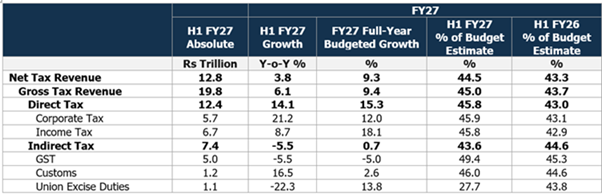
The ratings agency expects customs duties and GST collections to support gross tax collections, which are projected to surpass budget estimates in FY27. However, anticipated shortfalls in excise duty and income tax collections may lead to a gross tax revenue shortfall of Rs 1 trillion, according to CareEdge Ratings.
Dividend and disinvestment receipts
CareEdge Ratings said that higher dividend transfers and disinvestment proceeds could limit the overall slippage in the Centre’s receipts to Rs 0.5 trillion. In the first half of FY27, the Centre raised Rs 0.56 trillion from disinvestments, representing 70% of the full-year budgeted amount of Rs 0.8 trillion. This is a marked improvement over the same period last year. The announced IDBI Bank stake sale could bring in around Rs 260 billion, with total disinvestment and asset monetisation proceeds expected to reach Rs 1 trillion, surpassing the budgeted figure.
Dividend receipts are also expected to bolster overall receipts. The Centre had budgeted Rs 3.2 trillion in FY27 from the Reserve Bank of India (RBI), nationalised banks, and financial institutions, with the RBI’s surplus transfer alone accounting for Rs 2.9 trillion. Since FY25, the RBI’s surplus transfer has exceeded Rs 2 trillion annually, providing the Centre with additional fiscal space. Overall, revenue from dividends and profits is expected to marginally exceed the budgeted amount.
Capex and subsidy trends
The Centre’s capital expenditure rose by 12.7% in the first half of FY27, with the Ministry of Railways and the Ministry of Road Transport and Highways accounting for the largest shares. Capital expenditure excluding outgo to the Department of Food & Public Distribution grew by 14% year-on-year. Capital transfers to states, driven by higher disbursements under the Special Assistance to States for Capital Investment (SASCI) scheme, made up 13.4% of total capital spending in H1 FY27, up from 9.8% a year earlier. However, full-year capex is expected to be marginally lower than budgeted.
On the expenditure side, the subsidy burden is projected to be higher by Rs 1.2 trillion compared to budgeted figures. Spending on major subsidies grew by 10.1% year-on-year in H1 FY27, led by a 16% increase in food subsidy expenditure and an 11.2% rise in fertiliser subsidy outgo, despite budgeted declines. Fertiliser subsidy is expected to be higher by around Rs 1 trillion for the full year, with food subsidy also marginally above budgeted levels. The increase in fertiliser subsidy is attributed to elevated urea prices following the onset of the West Asia conflict in April and May 2026, though global prices have since moderated.
Fiscal outlook and deficit management
CareEdge Ratings estimates that gross tax revenue will fall short of the budget estimate by about Rs 1 trillion, mainly due to weaker income tax and excise duty collections. Support from higher dividend transfers and disinvestments is expected to contain the overall receipts slippage to Rs 0.5 trillion. The total expenditure is projected to exceed the budgeted target by Rs 0.3 trillion, primarily due to higher subsidies, partially offset by revenue rationalisation and slightly lower capex.
Factoring in these elements, the fiscal deficit is expected to surpass the budgeted amount by Rs 0.7-0.8 trillion, with a fiscal deficit-to-GDP ratio of 4.3-4.5%. CareEdge Ratings noted that the Centre could use the Economic Stabilisation Fund of Rs 1 trillion to meet its fiscal deficit target, and does not anticipate any additional pressure on the Centre’s borrowings for the current year.
Disclaimer: This article is based on a press release provided by the concerned organisation and has been edited for style and clarity with the assistance of AI tools. BusinessFortnight does not verify, endorse, or take responsibility for the claims, figures, or statements made in the original release.

