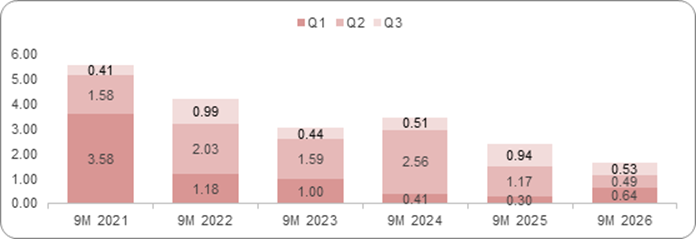
Mumbai, October 28, 2026: Private equity (PE) investment in Indian real estate fell 31% year-on-year to USD 1.66 billion in the first nine months of 2026, even as the number of transactions rose from 24 to 31, according to Knight Frank India’s Q3 2026 Capital Market analysis. The shift was driven by a sharp increase in domestic investor participation, which accounted for 85% of total investment, up from 25% a year earlier, as foreign investment declined.
The average disclosed deal size dropped 47% to USD 53 million, reflecting the absence of large-ticket transactions that had previously supported investment volumes. On a comparable nine-month basis, PE investment in 2026 was at its lowest level in six years, with investment more evenly distributed across the three quarters rather than concentrated in a single strong period.
Domestic capital dominates investment
Domestic investors contributed USD 1.42 billion in the first nine months of 2026, representing 94% of residential investment, 81% of office investment, and funding the only warehousing transaction during the period. Foreign investors contributed USD 0.24 billion, with 92% of this amount deployed through equity. The share of Indian PE investment rose from 25% in 9M 2025 to 85% in 9M 2026, with domestic investment increasing from USD 603 million to USD 1.42 billion. The expansion of Alternative Investment Funds (AIFs) and platform-led investments has created additional channels for domestic capital to participate in real estate.
Shishir Baijal, International Partner, Chairman and Managing Director, Knight Frank India, said the changing composition of real estate investment is as important as the headline numbers. “Domestic capital is playing a much larger role now contributing 85% of total PE investments in real estate, while investors are becoming more deliberate about the size, structure and risk of each commitment,” Baijal said.
Office assets and residential credit trends
The office segment attracted USD 1.18 billion, accounting for 71% of total PE investment during the first nine months, despite a 19% year-on-year decline. Ready office assets captured 78% of office investment, up from 49% in the same period last year, and 88% of office capital was deployed through equity. Investors have shown a preference for completed assets, reflecting a focus on established income streams and lower development risk.
Residential investment stood at USD 0.32 billion, down 33% year-on-year, with 97% of investment in the segment being debt-led and 83% directed towards under-construction projects. In Q3 2026, residential investments reached approximately USD 0.19 billion, representing around 60% of the segment’s nine-month total. The National Capital Region (NCR) received 63% of residential investment.
Warehousing and retail sector performance
Warehousing attracted USD 0.16 billion, entirely in Q3 2026, through a single transaction involving a ready asset. No PE investment was recorded in the retail sector during the first nine months of 2026, compared with USD 0.374 billion in the same period last year.
City-wise investment and future outlook
Among cities, NCR led with USD 0.568 billion (34% share), followed by Pune at USD 0.356 billion (21%), Chennai at USD 0.319 billion (19%), Mumbai at USD 0.276 billion (17%), and Bengaluru at USD 0.137 billion (8%). Hyderabad and Kolkata saw minimal or no PE investment in the period.
Higher return thresholds in overseas markets and rupee depreciation have weighed on foreign investment, while domestic investors, not exposed to currency risk, have assessed opportunities against alternative domestic investments. Real estate credit funds typically target returns of 15% to 18% per annum on developer lending, about 900 basis points above the yield on 10-year government bonds. Knight Frank India said private equity deployment will remain sensitive to asset quality, risk allocation, and currency-adjusted returns as global return thresholds remain elevated and foreign investors continue to be selective.
Disclaimer: This article is based on a press release provided by the concerned organisation and has been edited for style and clarity with the assistance of AI tools. BusinessFortnight does not verify, endorse, or take responsibility for the claims, figures, or statements made in the original release.