


































Aerospace 3D Printing
The additive manufacturing technology has gained high traction to initiate a revolution in the aviation industry.
PORTLAND, OR, UNITED STATES, March 31, 2023 /EINPresswire.com/ — The aerospace industry has always been at the forefront of innovation, and 3D printing technology is no exception. 3D printing, also known as additive manufacturing, has revolutionized the way aircraft components are designed, manufactured, and assembled. In this blog, we’ll explore the impact of 3D printing on the aerospace industry and how this technology is transforming the way we think about aircraft design and production.
𝗥𝗲𝗾𝘂𝗲𝘀𝘁 𝐒𝐚𝐦𝐩𝐥𝐞 𝐏𝐃𝐅 𝐚𝐭: https://www.alliedmarketresearch.com/request-sample/16181
The additive manufacturing technology has gained high traction to initiate a revolution in the aviation industry. The major aviation and aerospace companies such as Boeing and Lockheed Martin have invested heavily through early-stage ventures for leveraging the benefits of additive manufacturing hardware, software, and materials. Large-scale additive manufacturing machines capable of printing mission-critical metal components through part consolidation of new-generation aircraft will offer remunerative opportunities for the market growth.
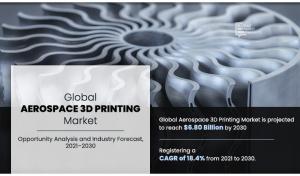
According to a recent report published by Allied Market Research, titled, “Aerospace 3D Printing Market by Printing Technology, Platform, Application, Delivery, and Offering: Global Opportunity Analysis and Industry Forecast, 2020–2030,” the global aerospace 3D printing market was valued at $1.38 billion in 2020, and is projected to reach $6.80 billion by 2030, registering a CAGR of 18.4% from 2021 to 2030.
Advantages of Aerospace 3D Printing:
Design Flexibility: 3D printing allows for the creation of complex geometries and intricate shapes that are difficult or impossible to produce using traditional manufacturing methods. This enables designers to create lighter, more efficient, and more aerodynamic parts.
Cost Savings: With 3D printing, parts can be produced more quickly and at a lower cost than with traditional manufacturing methods. This reduces the need for expensive tooling and allows for more efficient use of materials, resulting in significant cost savings.
Improved Performance: 3D printing allows for the creation of parts with improved performance characteristics, such as greater strength and durability. This is particularly important in the aerospace industry, where parts must be able to withstand extreme conditions and meet strict safety standards.
Customization: 3D printing allows for the customization of parts to meet specific requirements or individual customer needs. This is particularly useful for the production of small quantities of specialized parts.
𝗜𝗻𝘁𝗲𝗿𝗲𝘀𝘁𝗲𝗱 𝘁𝗼 𝗣𝗿𝗼𝗰𝘂𝗿𝗲 𝘁𝗵𝗲 𝗥𝗲𝘀𝗲𝗮𝗿𝗰𝗵 𝗥𝗲𝗽𝗼𝗿𝘁? 𝗜𝗻𝗾𝘂𝗶𝗿𝗲 𝗕𝗲𝗳𝗼𝗿𝗲 𝗕𝘂𝘆𝗶𝗻𝗴 – https://www.alliedmarketresearch.com/purchase-enquiry/16181
The software segment is expected to have a notable market share overcoming yours through recognition of new revenue streams. Predictive modeling, which can be leveraged through comprehensive software platforms enables OEM to ensure first-time quality and scale, eliminating manufacturing errors and last-minute design changes. The recognition of this methodology has led to the establishment of several software-based companies for additive manufacturing processes.
By printing technology, the global aerospace 3D printing market is segmented into selective laser sintering (SLS), selective laser melting (SLM), binder jetting, fused deposition modeling (FDM), stereolithography (SLA), and others. The binder jetting segment is expected to witness the highest growth potential over the coming year, due to its vast scope of binder jetting technology in the aviation and space industry. On the basis of platform, the market is categorized into aircraft, unmanned aerial vehicles (UAV), and spacecraft. The aircraft segment will witness the highest market share during the forecast timeframe, due to the maturity of the industry vertical.
Key Findings Of The Study
By printing technology, the binder jetting segment is expected to lead the market during the forecast period.
On the basis of platform, the UAV segment is likely to dominate the market.
Depending on application, the product segment is expected to grow at a lucrative growth rate from 2021 to 2030).
As per delivery type, the service segment is expected to exhibit the highest aerospace 3D printing industry growth.
By offering, the material segment is likely to dominate during the forecast period.
Asia-Pacific is anticipated to exhibit the highest CAGR in the coming future.
The key players operating in this market are Markforged, Liebherr, Stratasys Ltd., Materialise NV, EOS GmbH, 3D Systems Corporation, Honeywell. General Electric, Exone, Norsk Titanium, Renishaw PLC, TrumpF, SLM Solutions, Envisiontec, Inc., Prodways, and Hoganas AB
𝗣𝗿𝗼𝗰𝘂𝗿𝗲 𝗥𝗲𝘀𝗲𝗮𝗿𝗰𝗵 𝗥𝗲𝗽𝗼𝗿𝘁 (358 𝗣𝗮𝗴𝗲𝘀 𝗣𝗗𝗙 𝘄𝗶𝘁𝗵 𝗜𝗻𝘀𝗶𝗴𝗵𝘁𝘀, 𝗖𝗵𝗮𝗿𝘁𝘀, 𝗧𝗮𝗯𝗹𝗲𝘀, 𝗙𝗶𝗴𝘂𝗿𝗲𝘀) 𝗮𝘁: https://www.alliedmarketresearch.com/aerospace-3d-printing-market/purchase-options
Allied Market Research
Allied Market Research
+1 800-792-5285
email us here
Visit us on social media:
Facebook
Twitter
LinkedIn